The Reluctant Revolutionaries
So we must engage in revolution. Like with 1789, it is rebellion as an act of survival.
(Forgive the singing later; that is not an easy bit to sing.)
Bienvenue, freres, soeurs, un adelphes! Miss Dee Jay here. So… after last week’s paean to Pink Floyd, what might be on the agenda for this round? Well…
French musicals.
No, seriously. I know that may sound odd, especially to my largely-English-speaking audience, but French musicals fit quite well here, because we have revolutions to conduct, and worlds to turn upside down. Sometimes those revolutions are huge, earth-shattering events… and sometimes it’s as quiet and potent as standing up for ourselves as ourselves.
I first became interested in French musicals in 2019, through a somewhat roundabout route: I’d become a fan of the Takarazuka Revue while in Japan in 2018, and the versions they’d done of some noted French musicals had me seeking out the originals. I’m going to give a couple other musicals to look up at the end of this if you want to explore this area of music further, but there’s one explicitly revolutionary musical we’re going to need to explore today… and especially now.
1789: Les Amants de la Bastille.
Last year, Queer and Angry wrote a beautiful comparison between 1789 and the American musical Hamilton; I strongly recommend reading through that comparison, as it has some important points that will be alluded to here. Put very simply, 1789 speaks more to 2025 (and 2026) than Hamilton ever could. 1789 depicts the interplay, the corruption, and the callousness of the ruling classes in a much less flattering light than Hamilton’s George III, for instance. Hamilton’s heroes in the first act are young men, some well-to-do, who viewed rebellion as an act of upward mobility. 1789’s heroes by comparison are peasants, young men and women robbed by a greedy monarchy and nobility, forced to destitution and in some cases prostitution, ordinary people in ordinary circumstances feeling a steadily tightening noose of oppression and poverty. In other words, to its main characters, 1789's rebellion is an act of survival. (The 1789 musical in its entirety cam be found on Youtube here.)
Needless to say, 1789 - both the musical and the events of real life - has more to teach us than 1776 does.
That said, when I first encountered the musical 1789, a different sort of revolution was taking place. In May of 2019, after months of pressure and anxiety, to the point that I was near the end of my rope, I reached the transition point. I’d known I was trans for decades, but that moment in time, that May, was when I went, “I need to transition. This is going to kill me otherwise.”
And yes, make no mistake: transition is necessary revolution. The gender binary - and the perceived immutability of the biological gender binary - is so baked into Western society’s understanding of the world that to transgress that line in any way, shape, or form goes against everything that most cisgender people can understand. Moreover, our insistence on the mutability of physical gender and the fragility of that social construct of gender threatens every assumption that most cisgender people have of society's structure - and, by extension, what power is in society. If you doubt this, consider just how much access to power in American society, from social power to political power to financial power to religious power, is affected by the social construct of gender, from the simple safety of walking alone at night; to walking through the halls of Congress, the Pentagon, or the White House; to walking into the C-suite of a Fortune 500 company; to walking to the pulpit of your local church. Patriarchy is far more insidious and far more pervasive than most people realize - and trans people, by existing, are a threat to the assumptions underlying that patriarchy.
To transition, to declare one’s self some form of trans or non-binary, means to put ourselves outside of the traditional narratives, to challenge that power, with all of the risks that such an act entails. But most of us… we don’t have a choice. It was literally a “transition or die” point for me, and for so many others. Something in me instinctively reached for transition at that breaking point, and I am eternally grateful for that instinct.
So we must engage in revolution. Like with 1789, it is rebellion as an act of survival.
And the cost for many of us may be our lives. Challenging power - challenging patriarchy - challenging authority - is generally not known for being a safe act. But, again, many of us don't have a choice.
The finale of the 1789 musical is a song called “Pour la Peine”. Us trans people... we risk everything with our transition. We risk our families; our jobs; our homes; our lives. But we do this because to not become ourselves is pain, is suffering... is death. This revolution is our only way out; this revolution is our way home. (An English translation of the song can be found here. You may find it useful to open it before listening to the song, if you're not as familiar with French. )
"Pour la Peine", from 1789: Les Amants de la Bastille. Written by Jean-Pierre Pilot, Olivier Schultheis, Rodrigue Janois, William Rousseau, Dove Attia, Vincent Baguian.
Trans people... we engage with that revolution every day of our lives. To those that would see us dead, every day we walk out our door is an invasion. To those that would see us dead, every name and set of pronouns is a declaration of war. To those that would see us dead, every article of clothing that doesn't match some assumption from birth is a partisan's uniform.
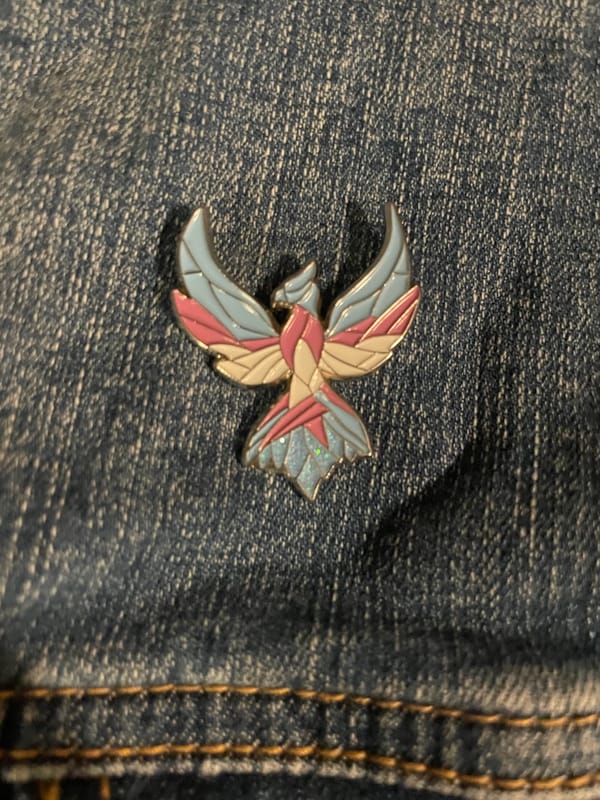
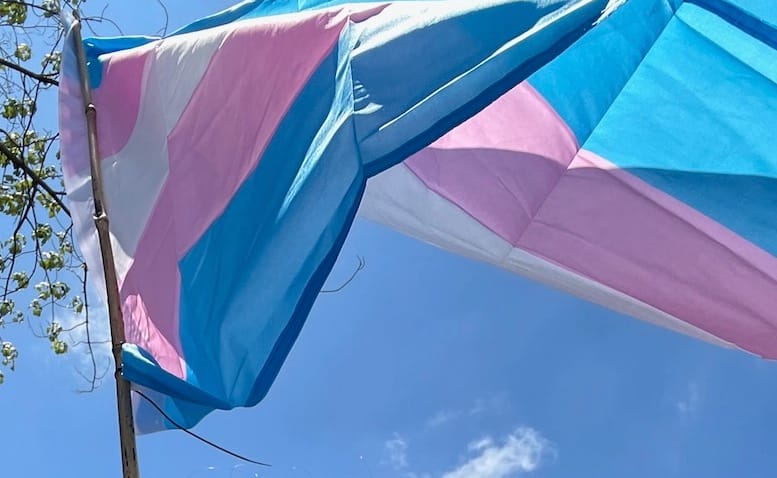
Maybe they're right. Maybe we are an invasion. We are certainly an affront to whatever lay in their barren philosophy. But it is either standing against them, or dying on our knees. We even have our own tricolor of light-blue, pink, and white, flying high for the day when peace would come.
on veut des rêves,
qui nous soulèvent,
on veut des fleurs,
a nos douleurs,
on veut du sens,
de l’innocence,
au nom de nos libres penseurs,
au nom des larmes,
qui nous désarment,
on doit pouvoir,
changer l'histoire,
pour la peine.
And, like putting on the old tricolor back in the day, we put on our own colors, announcing our revolution to the world.
A revolution to change history - our history.
Pour la peine.
Earlier, I promised some suggestions as to French musicals to look up. To that end... a few you might find interesting:
Mozart: l'Opera Rock. From the same group that did 1789, it tells the story of Mozart's career from about age 17 to his death at 35. (Entire musical on Youtube here.)
And, also, Romeo et Juliette. The classic story of star-crossed lovers, done in a rock-opera format. (Entire musical on Youtube here.)